Blog / · 6 min read
Cursor Teams now has two fuel gauges. Good luck driving that.
Cursor announces more included usage for its Teams plan and a new Premium seat at 120 dollars. Except now you have to watch two separate usage pools instead of one. The simplicity of the flat plan just took another hit.
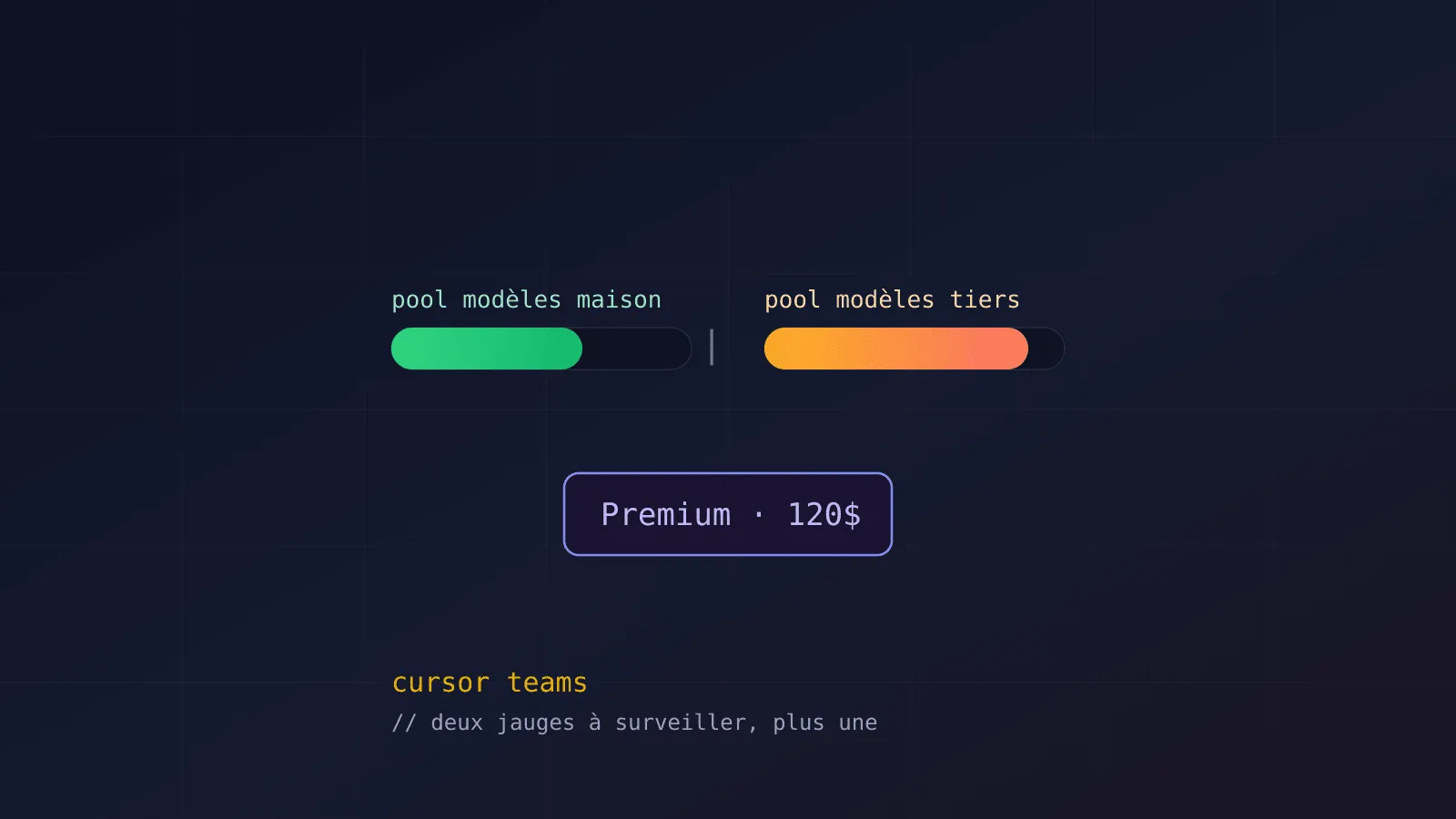
Since July 1, 2026, every Cursor Teams seat has two usage meters instead of one.
One pool for the house models, Auto and Composer 2.5. Another pool for third-party models, Claude, GPT, Gemini. They don’t top each other up. They don’t offset each other.
Cursor presents this as a gift: more included usage, a new Premium seat for heavy users. On paper, that’s true.
Except I mostly see one thing. A team that used to manage one budget now has to manage two. And guess which one hits zero first.
Okay. Let’s look at what this actually changes.
What Cursor announced, without the polish
The official announcement from July 1, 2026 comes down to three points.
First point, the pools are separate. The Standard seat still costs roughly the same, but its usage is now split across two distinct reservoirs instead of one shared bucket.
Second point, a new Premium seat shows up. It gives five times the included usage of Standard, for about three times the price. Concretely, Standard sits around 32 dollars a year or 40 monthly, Premium around 96 dollars a year or 120 monthly.
Third point, the dashboard gets better. Cursor adds proximity-to-limit indicators, seat recommendations, and configurable financial-threshold alerts on Slack or email.
Taken in isolation, each point is defensible. More included usage, a pricier seat for power users, better alerts. It’s actually pretty reasonable compared to other recent AI pricing moves.
The problem isn’t in any single point. It’s in the overall structure.
Why two pools changes everything for planning
With a single pool, a team’s question is simple: how much do we have left this month.
With two pools, the question becomes: how much is left in the house pool, how much is left in the third-party pool, and which one is going to run dry first depending on what each dev is doing.
This isn’t just twice the dashboard reading. It’s a real allocation problem.
A dev who mostly uses Auto and Composer will drain the house pool without touching the third-party one. Another who works almost exclusively with Claude or GPT will do the opposite. Across a team of ten people with different habits, you end up with seats where one pool is empty while the other is still three-quarters full.
And then you’re stuck with two options, neither of which is great. Either you pay overage on the dry pool while the other one sits idle. Or you force devs to switch models mid-month to rebalance, which is basically asking them to do inventory management instead of coding.
Neither option counts as a readable flat rate.
The connection to what’s happening elsewhere
We’d already seen Copilot move to AI credits in early July. I wrote about it in an article on the end of the magic flat rate, with the same underlying idea: a coding agent isn’t a chatbot, it’s a machine that burns compute, and a flat plan couldn’t absorb that forever.
Cursor confirms the trend, but with a nastier twist. Copilot made visible a cost that already existed, inside a single-meter system. Cursor just splits the meter in two.
It’s more technically refined. It lets Cursor sell more usage on house models without blowing up its infra cost on third-party models, which are billed by API and therefore much less profitable for them. Makes sense on the business side.
But on the user side, it means more surface to monitor, more decisions to make mid-month, more “why did we pay overage this month” to explain to the boss.
Standard or Premium, how to decide for a small team
Here’s how I’d think about this choice for a team of 5 to 15 devs.
First, look at who uses what. If most of the team runs on Composer 2.5 or Auto for the bulk of daily work, the “five times more usage” angle of Premium is almost useless, since that house pool is already generous on Standard. Premium only becomes interesting for the ones who hit the third-party pool hard, typically tasks where Claude or GPT get called in for heavy reasoning, architecture, or gnarly debugging.
Next, don’t put the whole team on Premium at once. Cursor lets you mix seats. Use that. Give Premium to the two or three devs who actually run heavy agents on long tasks, and keep Standard for the rest. A mixed seat setup often costs less than an all-in Premium bet, and above all it matches real usage instead of a collective gamble.
Then, turn on threshold alerts from day one, not after the first bad billing surprise. Set them on both pools separately, with a threshold at 70 percent and another at 90. The goal isn’t to get alerted once it’s burned, it’s to get alerted early enough to change behavior within the current month.
Finally, check the seat recommendation dashboard after a full month of real usage, not after a week. The first month of a new pricing tool is never representative, team habits shift, some people test everything, others stick to their old reflexes.
What this says about the 2026 market
We’re moving out of the world where AI coding sold like a Netflix subscription. One price, one access, no thinking required.
We’re entering a world with multiple gauges, where each vendor segments usage according to its own internal cost structure. Cursor separates house and third-party because its margin isn’t the same on both. Tomorrow another player will find its own split, maybe by task type, maybe by agent duration, maybe by context token volume.
The real change isn’t the price going up or down. It’s that the bill becomes unreadable without a minimum of internal tooling to track it.
For a small team, that means one concrete thing: you now need someone, even part-time, to check these dashboards once a week. Not because it’s exciting. Because otherwise, you discover the overage on billing day, and by then it’s too late to adjust anything.
The nice marketing headline, “more included usage,” is true. But it hides the real 2026 question: how much human time does it take, every month, to understand what you’re actually paying for.
Sources
Keep reading