Blog / · 5 min read
Mistral is back with a "fat but sparse" MoE: the sovereignty bet with no proof attached
Arthur Mensch announces a massive new open-weight model, in restricted early access since July. No public benchmarks, no announced license. Just a promise to catch up with the frontier, made in Europe.
Mistral has a new model. We know it’s big. We know it’s “sparse”. We know Arthur Mensch talks about it as the next move to catch up with the closed US models.
That’s about all we know.
No public benchmark. No announced license. No public release date, just early access reserved for partners since early July. And yet it’s already making noise as if it were the return of Europe’s AI king.
Okay. Let’s look at what’s actually on the table, and what isn’t.
What we know, and it’s short
Mensch confirmed a new family of Mixture-of-Experts models, described by himself as “fat but sparse”. Big overall, but sparse at execution time.
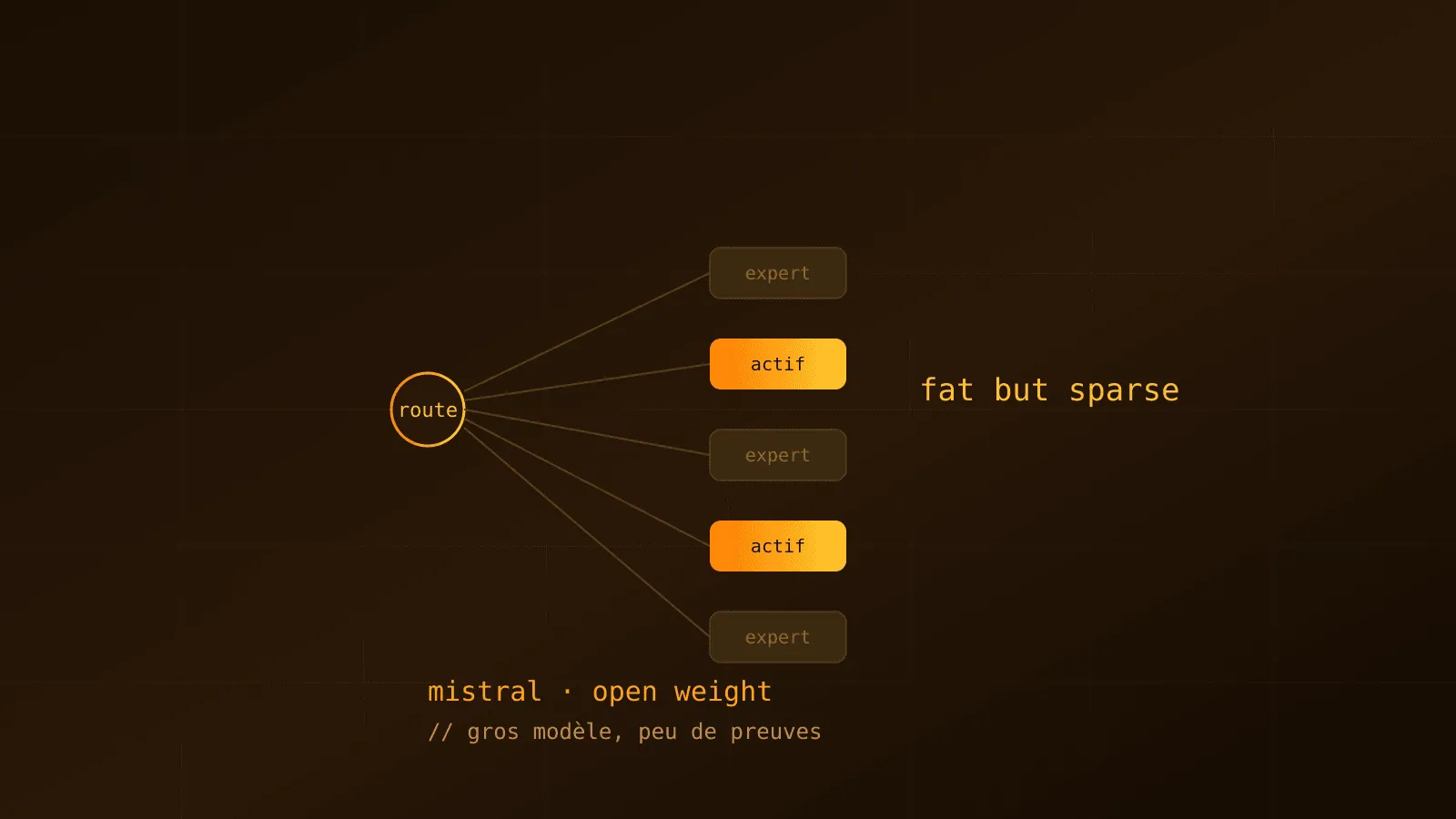
For anyone who doesn’t live in MoE vocabulary day to day: a Mixture-of-Experts model is a bit like a company full of different specialists (the “experts”), with a router that decides, for each token, which specialists will handle the request. You can have a huge total parameter count, but only a fraction actually runs for each computation. That’s exactly the architecture behind Mixtral back in the day, and behind most recent large models, DeepSeek leading the pack.
The model entered early access for partners in early July 2026. A broader open-weight release is mentioned as the logical follow-up, but nothing is precisely dated at this stage.
That’s it. That’s the whole package of confirmed information. No precise parameter count published officially. No MMLU benchmark, no score on any code or reasoning leaderboard. Not a word on the license: Apache 2.0 like previous Mistral models, a more restrictive “research only” license, or something else. We don’t know.
I’m saying this plainly because it’s the whole point: at this stage, we’re looking at an announcement of intent, not a product you can evaluate.
The silence on the numbers is itself a signal
What bothers me isn’t the absence of benchmarks as such. Companies often hold back their numbers for the official launch, that’s a standard marketing practice.
What bothers me is the timing. We’re in the middle of a communication battle around European AI sovereignty, with announcements dropping almost every week on the subject, and Mistral picks this exact moment to tease a model without showing anything concrete. This looks more like a communication response to the surrounding pressure than a controlled product launch.
I’m not saying the model will be bad. I have no idea, nobody has a verifiable idea at this point. I’m just saying a teaser with no numbers, in this context, deserves to be read for what it is: an announcement that sells a trajectory, not a result.
The real test will come the day independent evaluators, outside Mistral, can run the model on concrete tasks. Until that day comes, anything said about its performance is speculation, mine included if I were to risk any.
What exactly does the sovereignty argument rest on
The “European answer to closed US models” narrative is comfortable. It checks every box: data control, independence from Big Tech, possible hosting on European soil, no dependency on a single Californian company.
On paper, that speaks to any company with regulatory constraints, public sector clients, or just an IT department that doesn’t want its data flowing through American servers.
The problem is that sovereignty doesn’t get decreed with a teaser announcement. It gets proven with real hosting, verifiable SLAs, an inference infrastructure that holds up under production load, and support that answers when something breaks on a Friday night. None of that is demonstrated today for this specific model. We have an architecture promise, not a service offering.
And even assuming the model delivers on its technical promises: a massive open-weight model, “fat” as it’s described, is still a beast to host. If you actually want to capture the sovereign advantage, you either need to self-host on your own infrastructure (which assumes a GPU budget few teams have), or go through a European hosting provider who then becomes your new trusted intermediary. I made this same point about DeepSeek-V4: open-weight doesn’t mean open bar. Open weights never remove the question of who hosts it, where, and under what guarantees.
Is it worth betting on for a builder
Honestly, at this stage, no, not yet. Not because the model is bound to disappoint, but because there’s nothing to evaluate.
Here’s what I’d do if I were on a team watching this closely:
- Don’t migrate anything, don’t plan anything serious around this model until a credible external evaluation comes out. The numbers Mistral itself will publish at launch deserve the same caution as any vendor marketing number.
- Watch the license announcement closely. That’s often where the real practical value of an open-weight model gets decided: a permissive license changes everything for self-hosting, a restrictive one reduces the interest to little more than a marketing argument.
- Keep using Claude, GPT, or already-proven models for current production work. Betting on an early-access model for code running in production is betting on underspec, not on data.
- If data sovereignty is a real constraint in your context (public sector, healthcare, regulated finance), look at what already exists and is verifiable today, rather than waiting for a model that has shown neither its scores nor its usage terms.
Mistral coming back into the massive model arena is good news for the diversity of the ecosystem, in principle. But good news in principle and a model you can use with confidence are two different things. Right now, we have the first. We’re waiting on the second.
Sources
Keep reading